· Case Study · 9 min read
How a bank chose Temporal : automation with humans inside
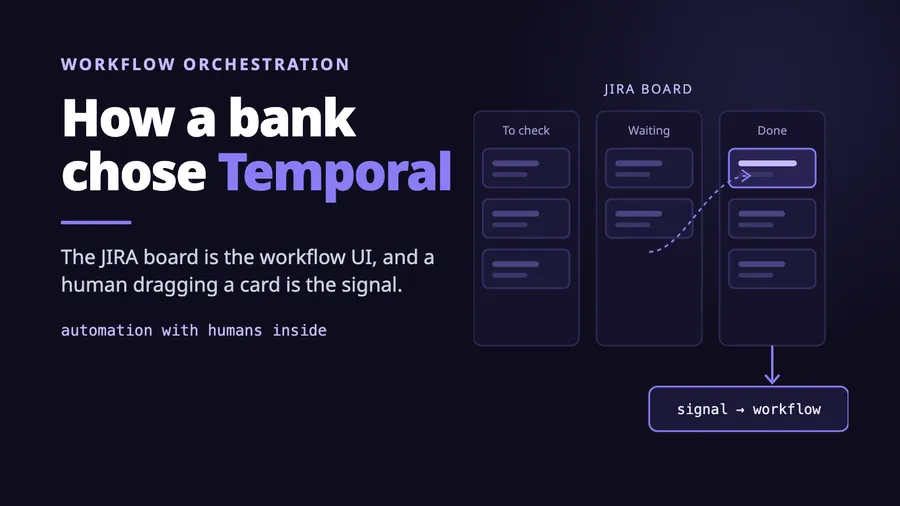
A human drags a JIRA card, a Temporal workflow moves on. The prototype behind a bank's choice 🤝
In 2024, my freelance mission dropped me into the biggest project a bank can run : replacing its core banking system. Beside the CBS itself, the inventory listed more than 80 business processes to migrate, and some of them were not automated at all : they ran on customer-support expertise.
The CBS world ran on choreography : events on Kafka, every service reacting to its neighbors, no central brain. Perfect for service-to-service flows, hopeless when someone asks “where is this file, and who is it waiting on ?” three weeks into a process. The long-running processes, the ones with humans inside, needed the opposite model : orchestration, one place that owns the state end to end, outside the CBS world. A study put Temporal on the short list, and my job was to prove it on the messiest of the lot. One more constraint came with the territory : the orchestrator had to join those Kafka exchanges without touching the existing services or their message schemas.
That is where business-workflow projects often get expensive. The automation part goes fine, until someone says : “step 4 needs a human”. And the classic answer is a brand-new back-office UI : a task list, a detail page, approve / reject buttons, an audit trail, authentication. Months of work nobody budgeted, for screens the operators never asked for.
Customer support did not need new screens. Their daily reality was email, Excel sheets and JIRA, and that is where the work already lived. So the prototype took the opposite bet : plug the workflow engine into the tools they had already adopted.
JIRA is the UI. The workflow engine projects its state onto their board, and reads their decisions back off it.
Here is how, in a 49-second demo ⏱️
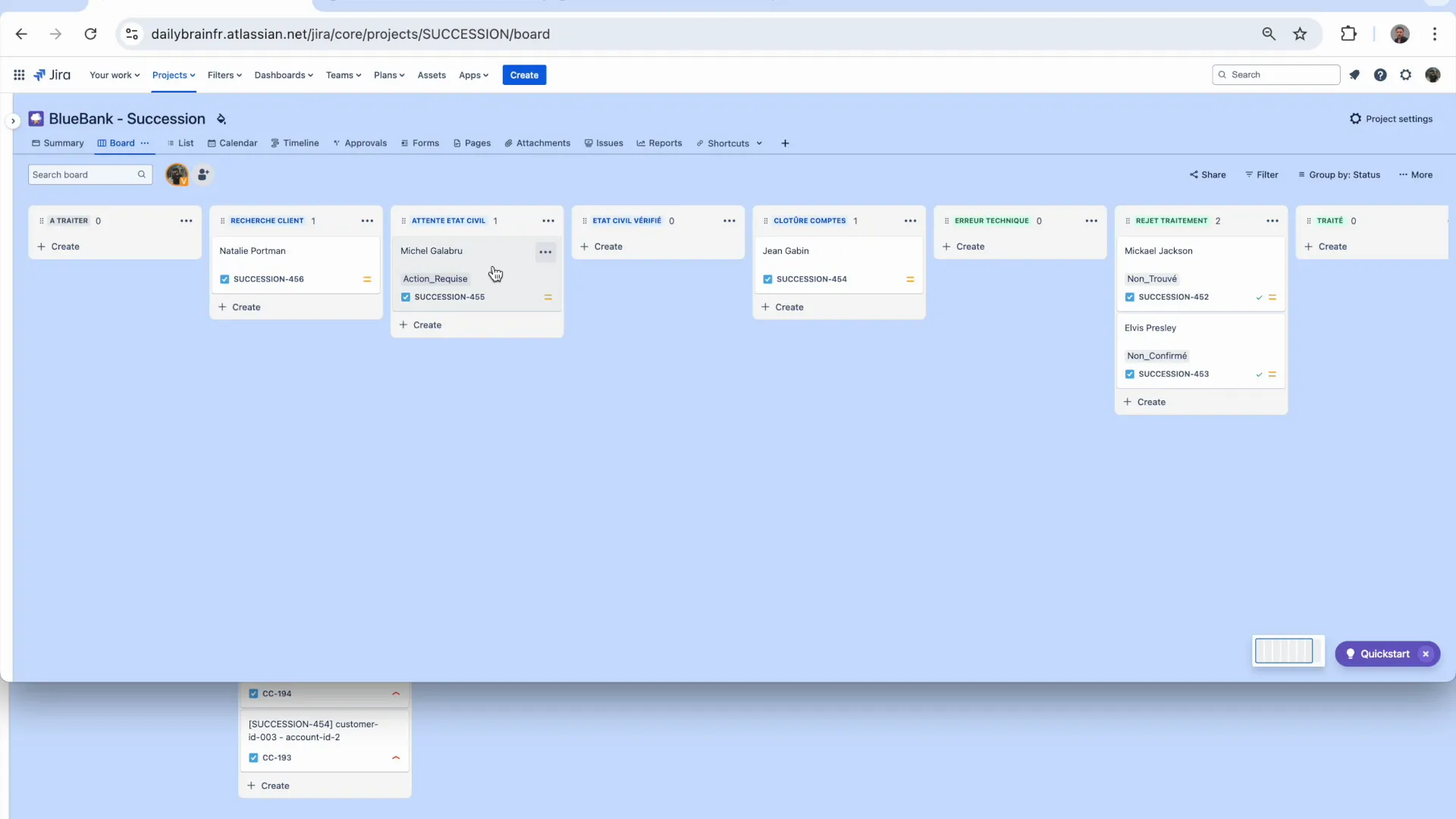
The full run : five cards created, the boards animating themselves, one human drag, and the Temporal Web UI behind it all.
The business : death, in French
The scenario is succession, estate settlement, picked straight from the list of 80 : until then it was handled entirely by customer support. A bank learns a customer may have died. It must verify the death against the civil registry, then close every account : block the card, block transfers, close the account, notify. Most steps are API calls. One is not : when the registry cannot confirm the death automatically, a human has to decide, and only on official confirmation, a paper letter or an email, which can take days, sometimes months. The workflow must hold its place the whole time, then resume exactly where it stopped. That requirement alone calls for durable, long-running execution, and narrows the field.
The prototype is a fictional BlueBank, and the code speaks French because the domain does : ClotureCompte is an account closure, VerificationEtatCivil a civil-registry check. Two JIRA boards, one per workflow, and a small cast of services :
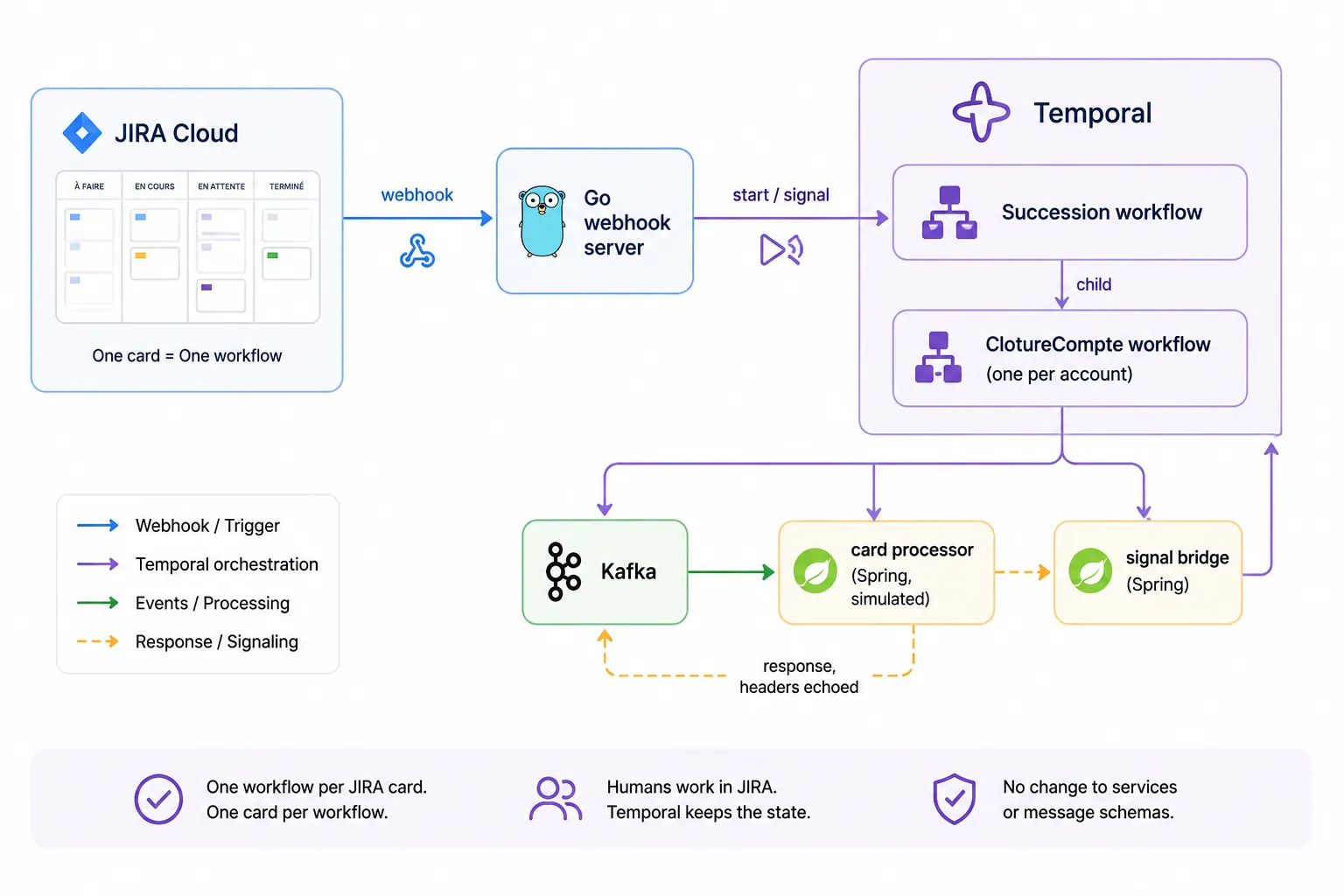
One workflow per JIRA card, and one card per workflow.
The trap : welding the board into the business logic
The obvious wiring is to sprinkle JIRA calls through the workflow : move the card here, add a comment there. It works for a demo and then rots : the business logic and the board choreography are welded together, and every board tweak is a workflow redeploy.
The worker interceptor is the way out. It wraps every activity and workflow execution on the worker, so cross-cutting code has one home. Mine does exactly one thing : it treats the JIRA board as a projection of the execution. Condensed :
func (a *activityInboundInterceptor) beforeActivity(ctx context.Context, in *interceptor.ExecuteActivityInput) {
  activityName := activity.GetInfo(ctx).ActivityType.Name  input := in.Args[0].(ClotureInput)
  switch activityName {  case "VerificationCompte":    a.updateJiraIssueWithTemporalInfos(ctx, input) // deep link to the Temporal Web UI    a.moveJiraIssue(ctx, input, JiraTransitionVerificationCompte)  case "BlocageCarte":    a.moveJiraIssue(ctx, input, JiraTransitionBlocageCarte)  case "BlocageVirement":    a.moveJiraIssue(ctx, input, JiraTransitionBlocageVirement)  case "FermetureCompte":    a.moveJiraIssue(ctx, input, JiraTransitionFermetureCompte)  }}
The activity name is the board column. When the worker starts BlocageCarte, the card slides to Blocage Carte, so the operators watch the workflow execute in real time, in the tool they already live in. And the workflow code never touches the board : no transitions, no comments, no labels. The business sequence reads like the procedure it implements :
func ClotureCompte(ctx workflow.Context, input ClotureInput) (bool, error) {  // retry policy & timeouts elided
  verified, err := verificationCompte(ctx, a, input)  // not verified ~> stop here
  err = blocageCarte(ctx, a, input)  err = blocageVirement(ctx, a, input)  err = fermetureCompte(ctx, a, input)
  if input.Initiative == JiraInitiativeBankWithNotice {    err = notificationClient(ctx, a, input)    err = workflow.Sleep(ctx, noticePeriod) // the legal notice period, durably  }
  return true, nil}
The workflow engine already knows the state. Project it, don’t rebuild it.
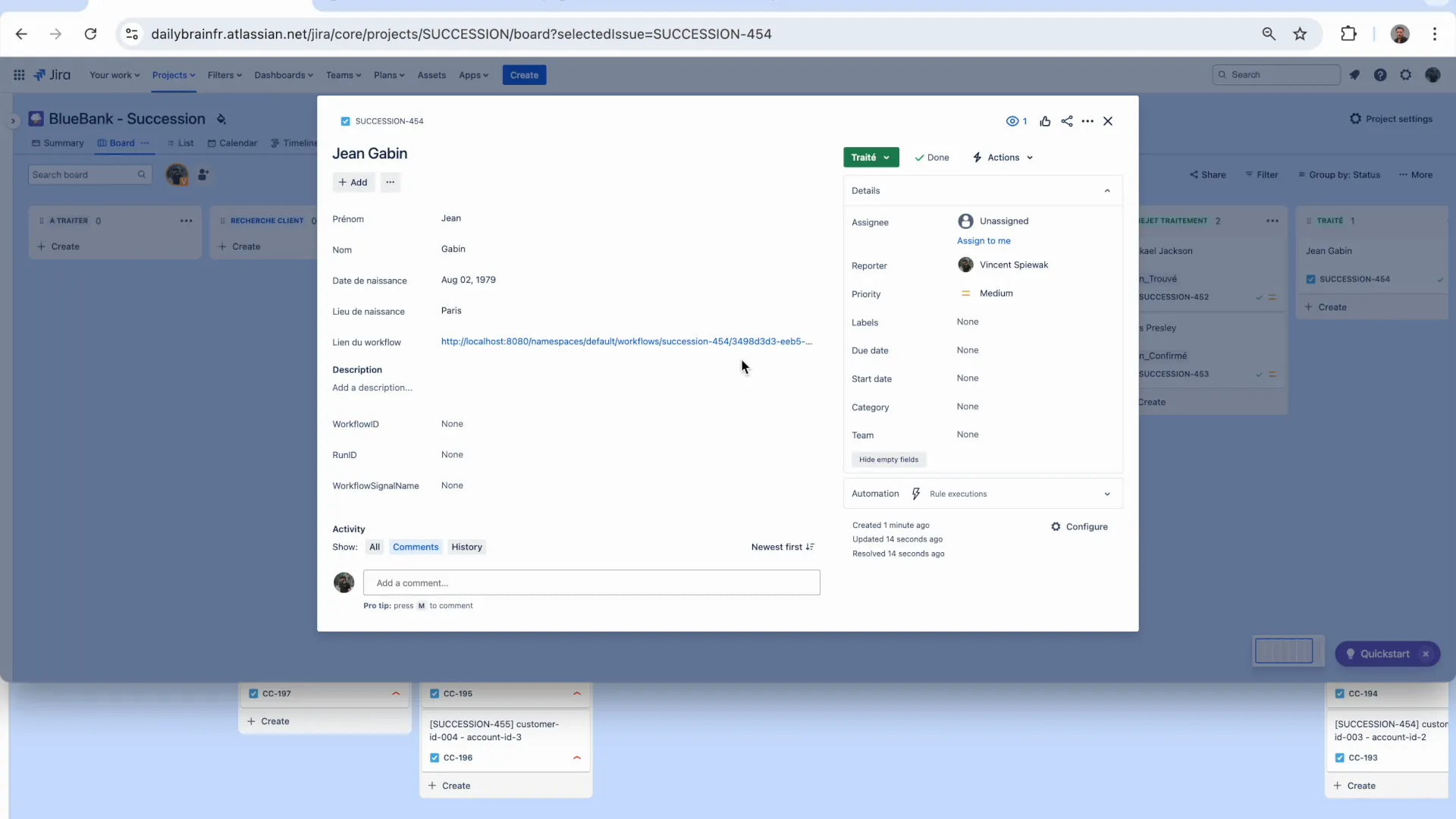
The interceptor also stamps a custom field with a deep link to the workflow’s history in the Temporal Web UI. From any card, one click lands an operator (or me, debugging) on the full execution trace.
Retries your back-office can see
The same interceptor turns failures into something a non-engineer can reason about. After every failed activity attempt :
if err != nil { a.commentJiraIssueWithError(ctx, input, err) // ADF panel : "#3 - Echec de l'activité BlocageCarte, raison: ..." a.moveJiraIssue(ctx, input, JiraTransitionErreurTechnique)}Because it fires per attempt, a flaky downstream leaves a visible trail : comment #1, comment #2, comment #3… then either the card moves on, or it parks in Erreur Technique with the whole story attached. The retry policy, usually invisible, becomes legible to the people who answer the customer’s phone call. That, more than any dashboard, is what made the demo land.
The outcomes get a taxonomy too, as labels : Non_Trouvé (not a customer), Non_Confirmé (very much alive), Echec (workflow failed). A back-office lead can filter the board by label and know exactly what needs whom.
The card carries its own return address
Now the human-in-the-loop part. When VerificationEtatCivil cannot confirm the death automatically, the interceptor writes the workflow’s own coordinates (workflow ID, run ID, and the name of the signal it is about to wait on) into three custom fields on the card, and flags it :
weId := activity.GetInfo(ctx).WorkflowExecution.IDrunId := activity.GetInfo(ctx).WorkflowExecution.RunID
a.root.options.JiraService.UpdateJiraIssue(input.IssueKey, fmt.Sprintf(  `{ "fields": { "%s":"%s", "%s":"%s", "%s":"%s", "labels": ["Action_Requise"] } }`,  JiraIssueCustomFieldWorkflowId, weId,  JiraIssueCustomFieldRunId, runId,  JiraIssueCustomFieldWorkflowSignalName, SignalNameEtatCivil,))
Then the workflow blocks on that signal, for days, sometimes months, durably :
selector := workflow.NewSelector(ctx)signalChan := workflow.GetSignalChannel(ctx, SignalNameEtatCivil)selector.AddReceive(signalChan, func(c workflow.ReceiveChannel, more bool) { c.Receive(ctx, &result)})selector.Select(ctx) // waits for the humanA human reviews the paperwork and drags the card to Etat Civil Vérifié, or to Rejet Traitement. JIRA fires its webhook, and the handler simply reads the three fields back off the card and signals, with a payload chosen by the destination column :
case moved && movedToString == "Etat Civil Vérifié":  weId := issue(JiraIssueCustomFieldWorkflowId)  runId := issue(JiraIssueCustomFieldRunId)  signalName := issue(JiraIssueCustomFieldWorkflowSignalName)
  temporalClient.SignalWorkflow(ctx, weId, runId, signalName,    &VerificationEtatCivilResult{IsVerified: true, IsDeathDeclared: true})
No correlation table, no lookup service, no polling. The work item is the correlation store, and the drag is the decision. Different column, different payload, different branch of the business, chosen by a human and recorded where humans work.
Orchestration meets choreography
Blocking the card goes through the card processor the way everything talks in the CBS world : a command on a Kafka topic, an event back, pure choreography. And existing services and message schemas must not change. So : same return-address pattern, different envelope. The activity stamps the workflow’s coordinates into the message headers, and the payload stays exactly what it always was :
headers := []kafka.Header{ {Key: "TEMPORAL_WORKFLOW_ID", Value: []byte(activity.GetInfo(ctx).WorkflowExecution.ID)}, {Key: "TEMPORAL_RUN_ID", Value: []byte(activity.GetInfo(ctx).WorkflowExecution.RunID)}, {Key: "TEMPORAL_WORKFLOW_TYPE", Value: []byte(activity.GetInfo(ctx).WorkflowType.Name)}, {Key: "TEMPORAL_SIGNAL_NAME", Value: []byte(SignalNameBlockCard)},}The processor does its work and echoes the headers back untouched on the response topic. On the other side, a generic signal bridge (four small Spring classes, no domain knowledge) reads the headers, rebuilds an untyped stub, and fires the signal :
var workflowStub = client.newUntypedWorkflowStub(        workflowId,        Optional.of(workflowRunId),        Optional.of(workflowType));
workflowStub.signal(signalName, input);
No topic changed, no schema changed, and the card processor never heard of Temporal. Its only job is what a good Kafka citizen does anyway : echo the headers it received. Orchestration on top, choreography underneath. The callback address travels with the message, so the bridge works for any workflow and any signal. A JIRA column drag and a Kafka response are the same thing to the workflow : a signal that finally arrived 😮💨
49 seconds, five endings
The demo script creates five cards in a row, one per branch of the taxonomy : a person who is not a customer, one who is very much alive, one whose death the registry confirms automatically, one who needs the human check, and one wired to fail on purpose. Forty-nine seconds later the board tells five different stories : rejected with Non_Trouvé, rejected with Non_Confirmé, closed straight through, parked on Action_Requise waiting for a drag, and parked in Erreur Technique with its retry trail in the comments.
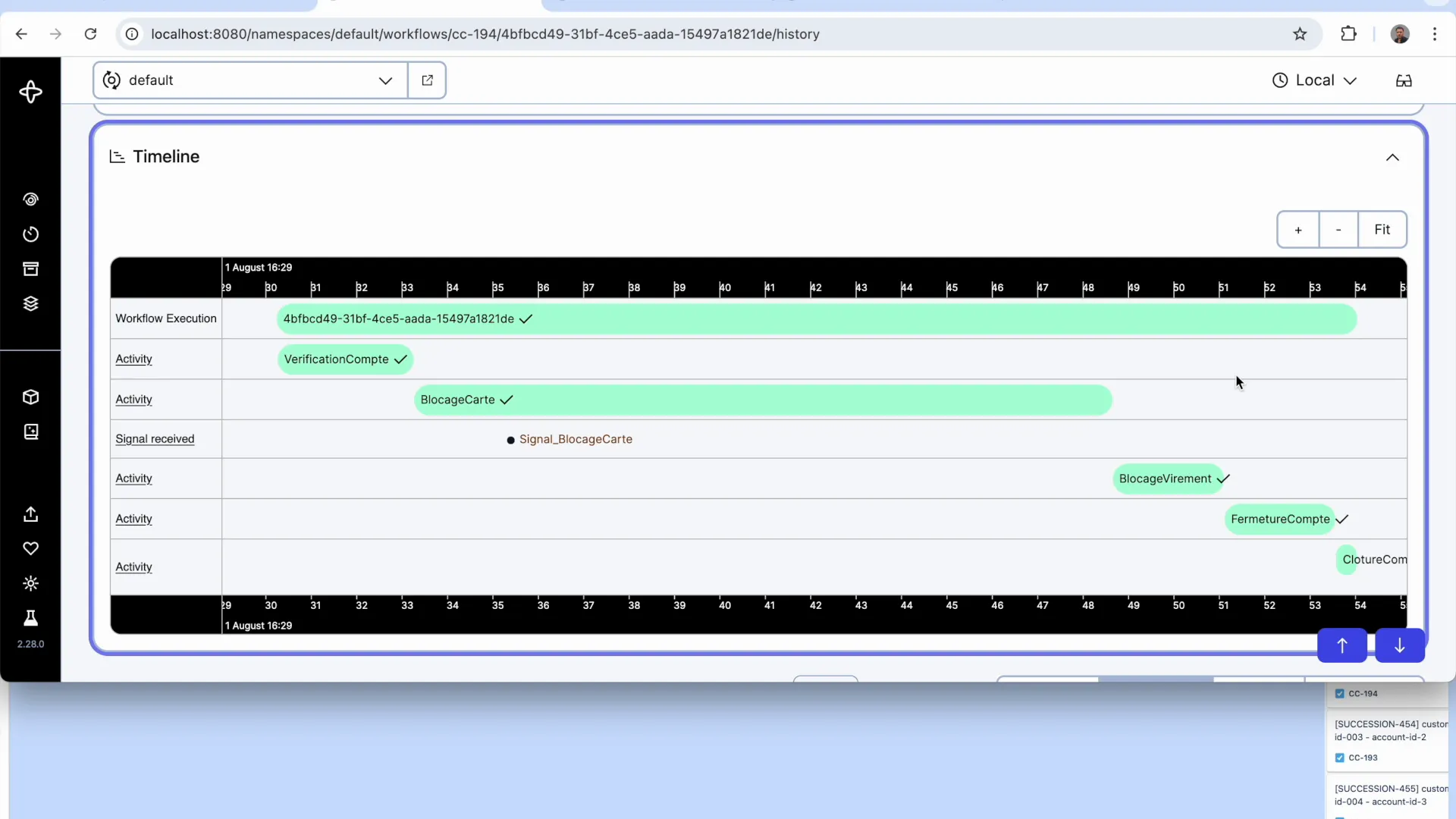
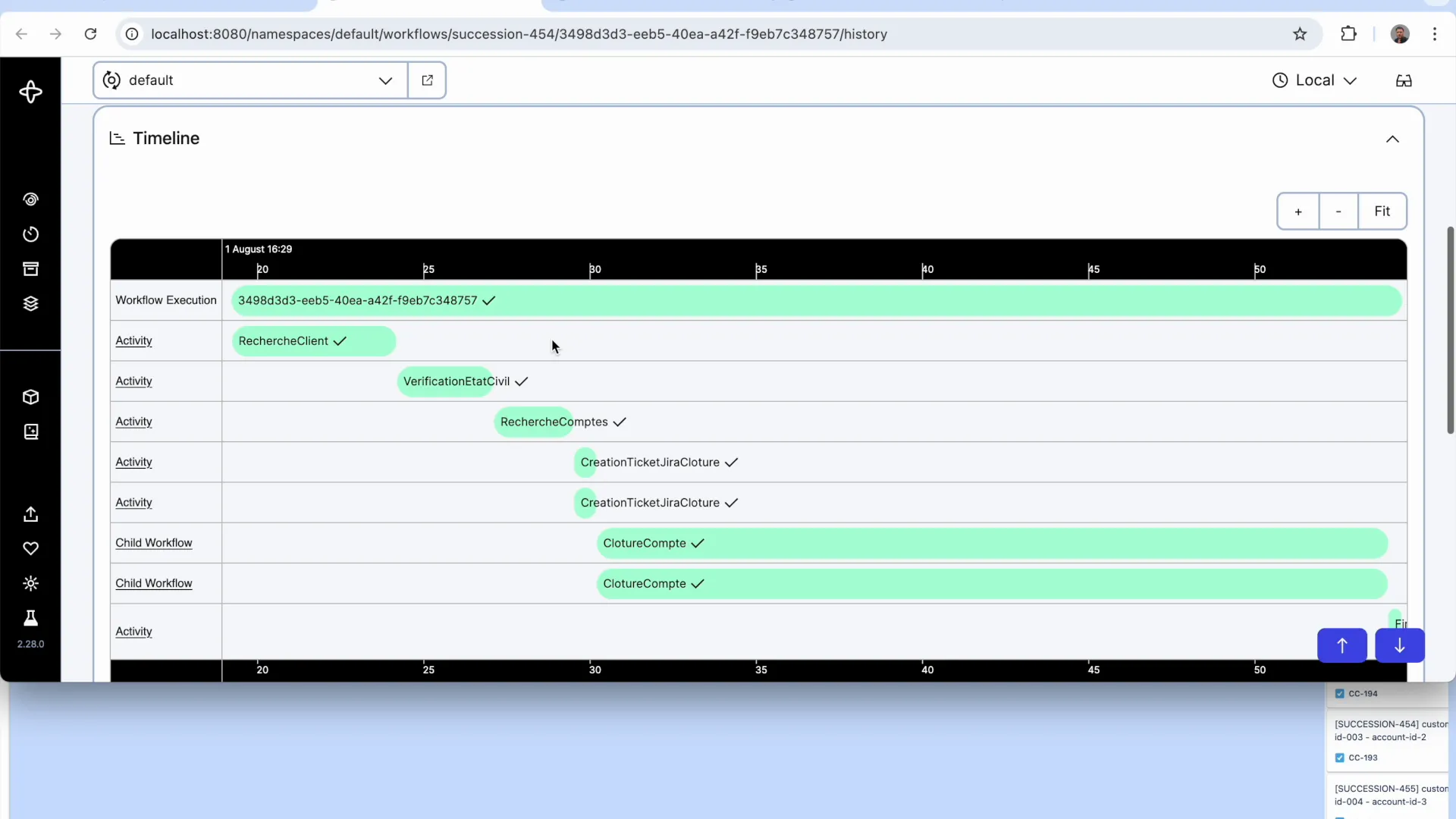
And the same story from the engine’s side, one Succession execution with three activities, two clôture tickets created, two ClotureCompte child workflows, 35 seconds end to end :
We showcased the run inside the bank. The back-office people watched cards move by themselves, dragged one, and understood the whole system in under a minute.
The steering committee validated the approach, and the bank adopted Temporal as its orchestration solution for the processes leaving the CBS world. A prototype’s adoption metric is binary : this one returned true ✅
What I would reuse
The return address, first. Whether it sits in custom fields on a card or in Kafka headers, the workflow’s coordinates travel with the work, and there is no correlation table to build or keep in sync. Then the interceptor : the board is a projection of the execution, so the business logic never calls JIRA.
And the human is a step, not a fallback. Some checks cannot be automated : a death the registry cannot confirm, a legal representative that only a letter or an email can attest. The workflow’s job is to wait well.