· Case Study · 10 min read
Migrating 1,273 repositories from Bitbucket to GitHub in under an hour
How I moved an entire data platform — full git history, CI/CD included — with a bash engine wrapped in a Temporal harness 🚀
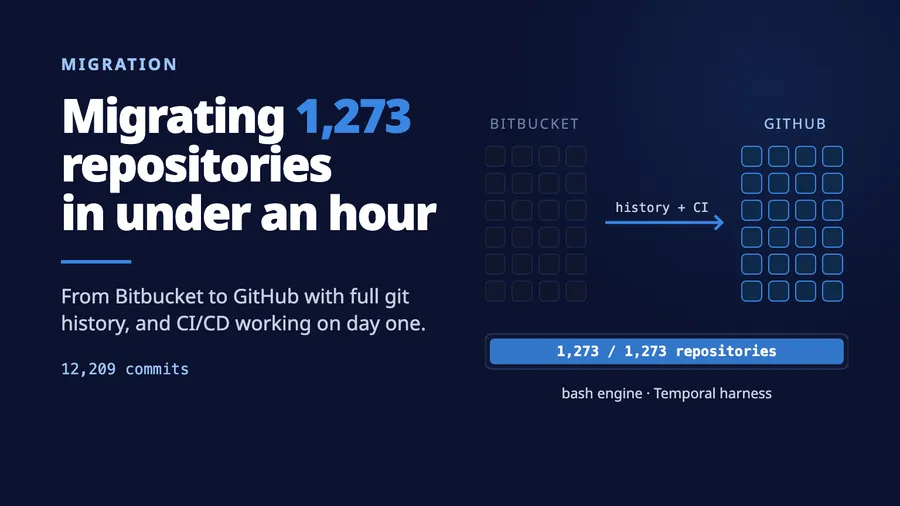
This summer, my freelance mission started with a one-line brief :
You have to migrate everything to GitHub before Christmas. You’ll have a buddy.
Everything being the data platform I had just landed on : 1,273 repositories — Spring Boot microservices, data pipelines, BigQuery executors, Dataflow jobs — living on Bitbucket, with all the CI/CD running on GCP Cloud Build.
The decision itself was already made : the group the company belongs to standardized on GitHub + GitHub Actions, so the platform had to follow. Which is actually the healthiest way to start a migration — nobody wastes six months debating tools. The deadline was set, the buddy was real, and the only interesting question left was execution :
Full git history preserved. CI/CD working on day one. A freeze window as short as possible, because a hundred developers were waiting to get back to work.
Total migration runtime : under one hour ⏱️
Here is how.
Silver linings first
Even a mandated migration comes with upsides, and for a fleet of repos they are massive :
- Topics as an addressing system. Every repo self-describes (
service,raw,batch, …). Any tool can later target “all services” with one API call. - Reusable workflows. One central repository defines the pipelines ; 1,273 repos call them. Fix once, fixed everywhere.
- A first-class API and CLI.
gh+ the REST/GraphQL APIs turn the fleet into something you can program.
Keep that word — fleet — in mind. It’s the theme of this whole story, and of the next one.
The constraints
A migration like this has a few non-negotiables :
- Full history. Branches, tags, every commit.
git logmust look identical on the other side. Nobody trusts a platform that ate their history. - CI/CD parity on day one. A repo without a working pipeline is a repo you cannot ship from.
- A clean cutover. The old repos must become read-only at migration time — a fleet with two writable sources of truth is a disaster generator.
- Proof. With 1,273 repos, “it looked fine” doesn’t scale. Every single repo needed a verifiable check : branches, tags, CI/CD, all accounted for.
- Speed. The longer the freeze, the more expensive the migration.
The naive loop is almost the answer
My first instinct — probably yours too — was a bash loop :
for repo in $(cat repos.txt); do git clone --mirror "git@bitbucket.org:acme/${repo}.git" cd "${repo}.git" git push --mirror "git@github.com:acme/${repo}.git" cd ..doneAnd honestly ? This is 80% of a git migration. git clone --mirror + git push --mirror moves branches, tags and full history — git does the heavy lifting for free.
But at 1,273 repos, the remaining 20% is where you die 💀 : pushes rejected because someone committed a target/ directory (or two 100 MB+ XML test fixtures) years ago, master vs main, repos that no longer exist, API rate limits, network resets mid-push. And one failure at repo #847 raises the real questions : which ones succeeded ? Can I re-run safely ? How do I prove the 846 others are complete ?
The answer wasn’t to throw bash away. It was to split the problem in two :
- an engine : idempotent bash primitives, massively parallelized — the thing that moves repos,
- a harness : a durable workflow — the thing that proves the move worked, for every single repo.
The engine : bash + GNU Parallel
Discovery & classification. A script fetches every repo slug from the Bitbucket API (OAuth2, credentials pulled from Secret Manager — nothing on disk). The legacy naming convention becomes the classifier : each prefix maps to a repo pattern — da_cd_svc_* → service, da_cd_raw_* → raw, da_cd_propagation_* → propagation, and so on. One legacy prefix was shared by two different workload types, so a hand-curated text file disambiguates them. Glamorous ? No. Effective ? Completely.
Renaming in flight. Cryptic legacy slugs like da_cd_svc_loyaltyservices land as acme-service-loyaltyservices : a brand-new, consistent naming convention — <platform>-<pattern>-<name> — born during the migration, plus topics assigned per pattern. A migration is the cheapest moment you will ever get to remove entropy. Take it.
Mirroring. The core of mirror-repo.sh, condensed :
git clone -q --mirror "git@bitbucket.org:acme/${source_repo}.git"cd "${source_repo}.git"
# the target org standardizes on 'main'if ! git show-ref --verify --quiet refs/heads/main; then  git branch -m master mainfi
git remote set-url origin "git@github.com:acme/${destination_repo}.git"
if ! git push -q --mirror; then  # push rejected → oversized files in history, strip and retry  git-filter-repo --path target/ --invert-paths  git push --mirror "git@github.com:acme/${destination_repo}.git"fi
The master → main rename happens inside the move — free entropy removal again. The fallback handles the archaeological finds : build directories and giant test fixtures committed to history long ago, stripped with git-filter-repo and re-pushed.
CI/CD : generate, don’t translate. Translating 1,273 Cloud Build configs one by one would be a death march — and would faithfully preserve years of per-repo drift 🙃. Instead, each pattern has a template directory : GitHub Actions workflows calling the central reusable ones, a Dockerfile, CI scripts. The generator copies the template, extracts the artifact name from the pom.xml, resolves a per-repo workflow config, converts the legacy properties into per-environment release files (six environments, from dev to prd), deletes the legacy config… and commits the result as a single Add Github CI/CD files commit. As a finishing touch, the latest Bitbucket tag becomes a proper GitHub release, changelog generated from the git log 🏷️
Day-one CI/CD parity, by construction — and the fleet comes out more consistent than it went in.
Composition. The engine is not one big script — it’s small scripts with one job each, composed like Unix commands :
migrate-all.sh # discovery, classification, fan-out└─ migrate-one.sh # per-repo guards : repo exists ? already migrated ? → skip └─ migrate.sh # the per-repo pipeline ├─ mirror-repo.sh # clone --mirror → master→main → push --mirror ├─ generate-cicd.sh # pattern template → workflows + release files ├─ push-changes.sh # the single "Add Github CI/CD files" commit └─ gh release create # latest Bitbucket tag → GitHub releaseAnd every level is idempotent : existence checks and skip-if-done guards mean any script can be re-run at any level — one repo, one pattern, or the whole fleet — and it only does the missing work. Idempotent + composable is what makes a migration debuggable : when repo #847 fails, you fix it and re-run its pipeline, not the world.
Fan-out. Idempotent scripts have another superpower : they parallelize for free. GNU Parallel provides the throughput :
parallel -P 50 "./migrate-one.sh {} >> /tmp/{}.log 2>&1" ::: "${repos[@]}"Fifty repos in flight at once, one log file per repo. Real numbers : run sequentially, a single pattern took 1 hour, 2 hours — up to 4 hours for the worst one. With -P 50, the ~90 service repos migrated in about 4 minutes with Maven build validation included — 2 min 16 s without — and the full 1,273-repo fleet fit under one hour. The engine stays boring on purpose — every hard guarantee lives in git itself ; parallel just multiplies it.
The harness : Temporal
Now the part that kept me sleeping at night 😴
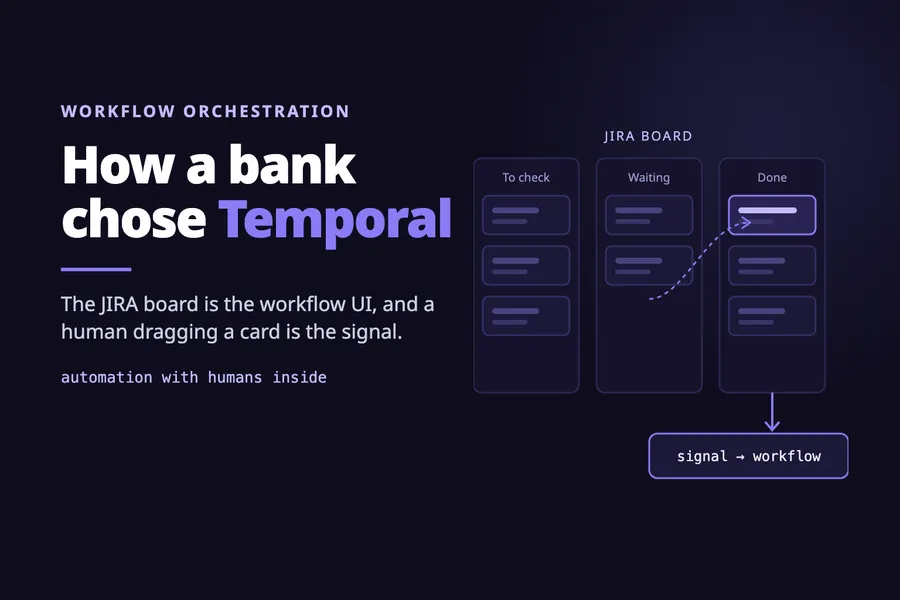
Moving the repos is one thing. Proving that 1,273 repos each arrived complete is another — that’s thousands of network probes against two git providers, and network probes flake. This is exactly the job for a durable workflow engine, so I built the verification layer with Temporal (Java SDK, JGit under the hood) :
// one child workflow per repository, all in parallelList<Promise<CheckRepositoryResult>> promises = new ArrayList<>();
slugs.forEach(slug -> {  CheckRepositoryWorkflow child = Workflow.newChildWorkflowStub(      CheckRepositoryWorkflow.class,      ChildWorkflowOptions.newBuilder()          .setWorkflowId(Workflow.getInfo().getWorkflowId() + "/" + slug)          .build());
  promises.add(Async.function(child::run, pattern, slug));});
Promise.allOf(promises).get();
Each child workflow runs five checks per repository : the repo exists on both sides, the pom.xml is at HEAD, the GitHub Actions files landed, branch parity (modulo the master/main rename) and tag parity. Every check is a Temporal activity — a flaky ls-remote retries itself with backoff instead of poisoning the result. The Temporal Web UI doubles as a live dashboard : priceless when someone asks “how is it going ?” every five minutes 😅
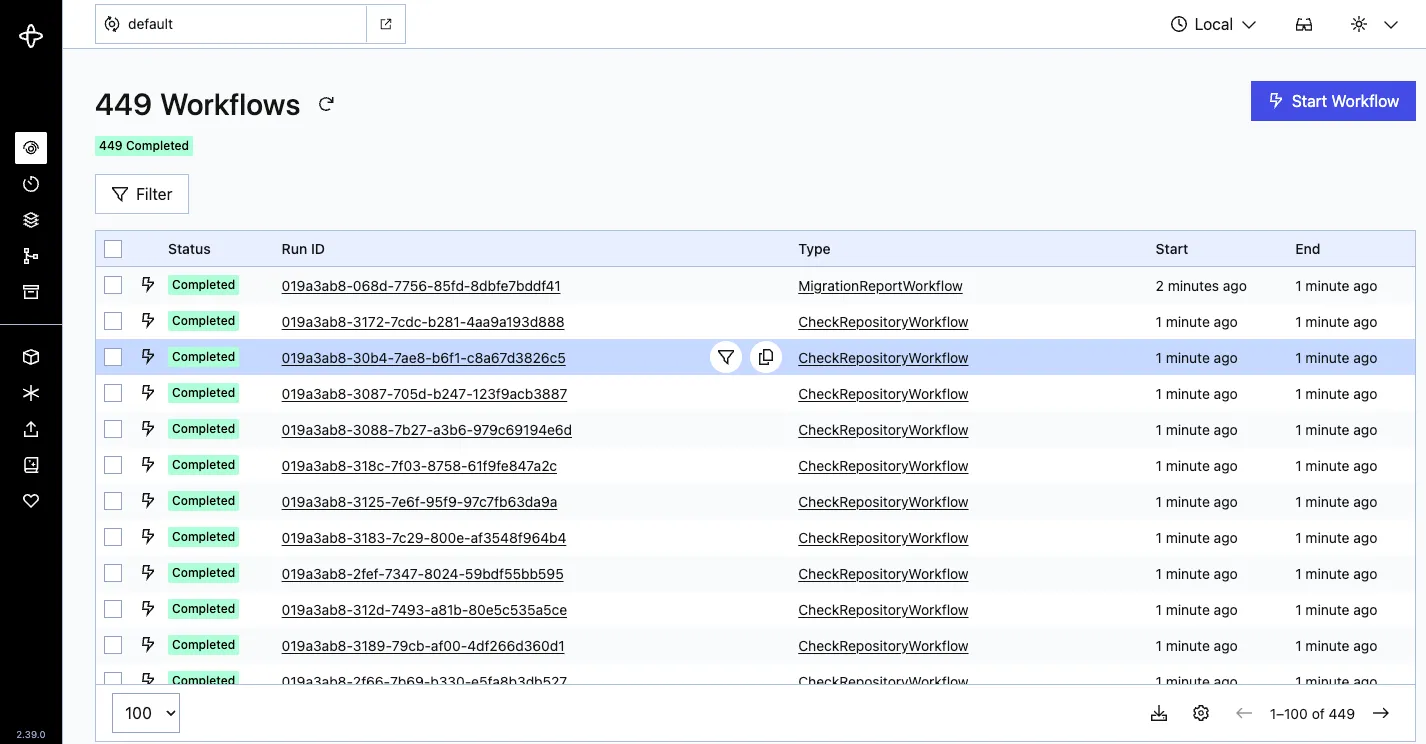
The output : one markdown report per pattern, one row per repo — the real thing :
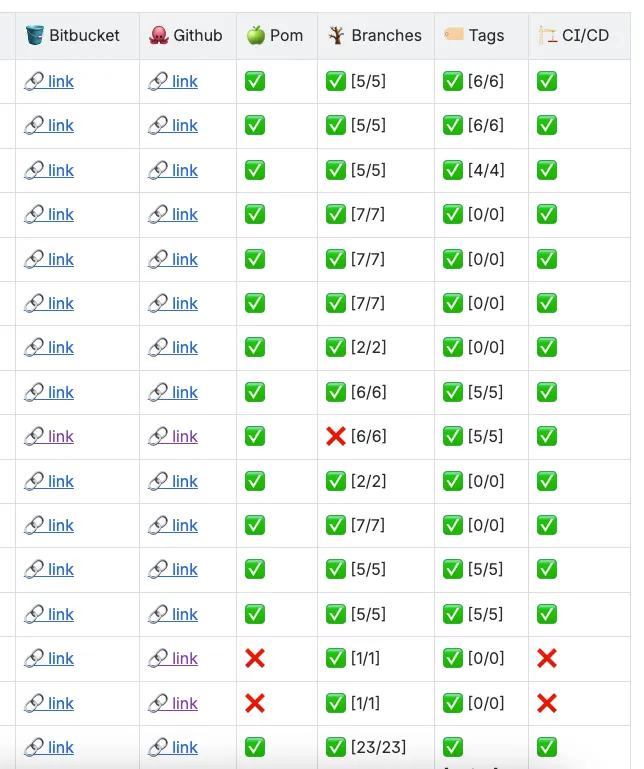
A ❌ meant : re-run that repo’s migration (idempotent, remember ?), re-run the report, watch it flip to ✅. You can even spot a branch-count mismatch caught red-handed in the middle of the table 🔍. Boring ? Extremely. Also the single most important artifact for adoption : when a team asked “is my repo really all there ?”, the answer was a link, not a promise 📄
And one twist for the purists : the harness can drive the whole thing — a top-level Temporal workflow chains clean-up → migration (the bash driver, wrapped as an activity) → verification → report. The engine stayed bash ; the harness knew how to drive it end-to-end.
Want to try the pattern ? I published a minimal, runnable version of this harness : temporal-bash-workflow — it runs the same per-repository child-workflow fan-out and markdown report against your own GitHub account 🚀
D-day
In the freeze window :
- Old Bitbucket repos flipped to read-only via the API — no split-brain, ever
- 1,273 repositories migrated — branches, tags, full commit history
- Every repo landing with working, generated GitHub Actions pipelines
- Under 1 hour total runtime, launched from my laptop
- Verification reports : all green ✅
GitHub’s own contribution page for that month tells the story better than I could :
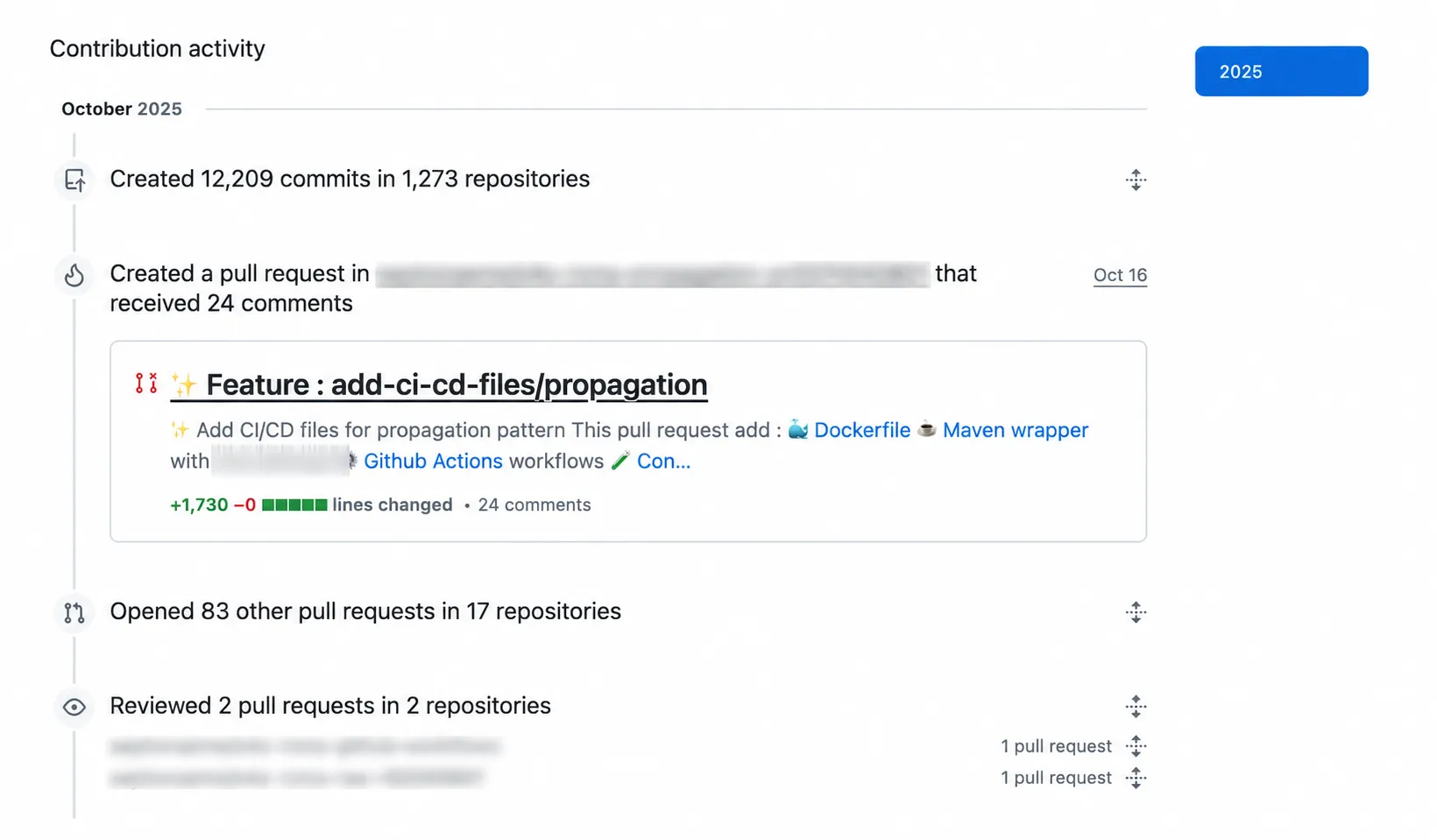
12,209 commits created in 1,273 repositories — as counted by GitHub itself. You can even see the machinery at work below the headline : a generated add-ci-cd-files pull request, +1,730 −0 lines, and the 24 comments of a real human review 👀
The longest part of the project was everything before that hour : building the primitives, dry-running patterns, fixing the archaeological repos, generating the CI/CD. The migration itself was pressing enter and watching the reports fill up with ✅
And the “before Christmas” deadline ? Delivered mid-October 🎄
Lessons learned
- Right tool per phase. A one-shot data move wants boring, idempotent scripts — git already provides the guarantees. Durable workflows earn their keep where you fan out thousands of flaky checks and need retries, state and a dashboard.
- Idempotent + composable beats cleverness. Small scripts, one job each, every one safe to re-run at any level : failures become boring, re-runs become surgical, and parallelism comes for free.
- Generate, don’t translate. Per-pattern templates gave day-one CI/CD parity and killed years of config drift in one move.
- A migration is the cheapest moment to remove entropy. Repo renames, a real naming convention,
master→main, topics — all free while everything is in flight anyway. - Verification is a deliverable. The ✅/❌ report is what turns “trust me” into “see for yourself”.
The real payoff came later
Here is the thing : the migration was worth it, but it was not the end of the story.
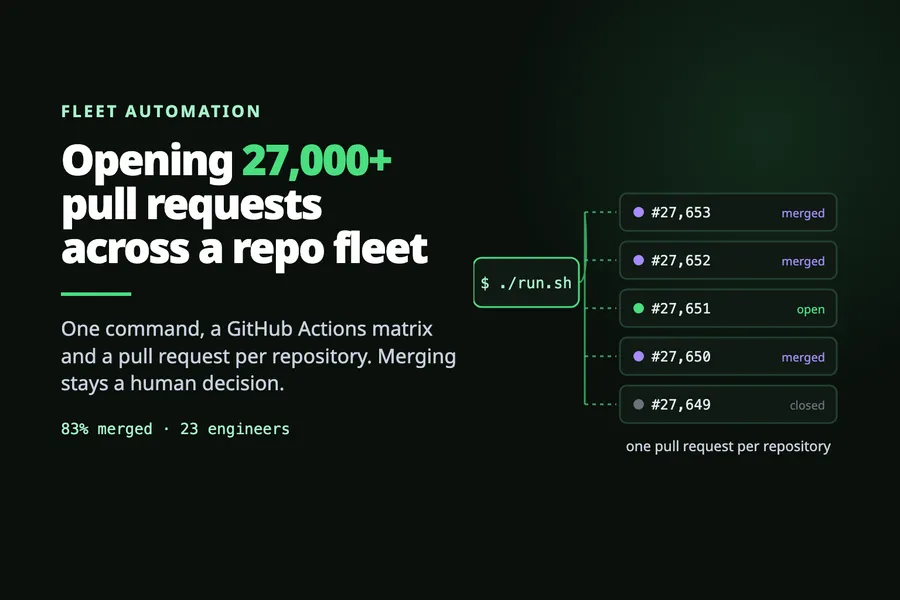
Once 1,273 repos sit on one platform, tagged with topics, named consistently, running generated pipelines from a central repository… you have something new : a fleet you can program. Those per-pattern template directories from the migration ? They became the direct ancestor of an auto-updater — a framework that opens pull requests across hundreds of repositories from a single command. Three months in, it has already shipped 3,000+ PRs, not one of them a push to main.
Moving 1,273 repos in under an hour turned out to be the easy part. Keeping a 1,300-repo fleet consistent afterwards is the real problem — and that is the next post 😉